
UAT plan template, acceptance criteria template, data mapping sheet, traceability matrix, 7 SQL data validation checks and an agent-ready requirements checklist. Plain Markdown, CSV and SQL.
What I do
I'm a business analyst. I take what stakeholders say they need and turn it into requirements a team can build and test, each with acceptance criteria and a clear line to the test that proves it. Then I check the data behind it in SQL and see the change through UAT, so it goes live the way the business expected.
- Requirements and user storiesElicitation, BRD and FRD, user stories with Gherkin acceptance criteria, business rules
- SQL data validationRow counts, control totals, duplicates, orphans, reconciliation bridges between two reports
- UAT planningEntry and exit criteria, test cases, defect triage, sign-off
- Data mapping and migrationSource-to-target mapping, data quality rules, mock cutovers, go/no-go
- ReportingPower BI and Excel, built from a list of decisions rather than a list of fields
- AI in BA workBriefing AI agents with testable specs, and checking what they produce against criteria set up front
Tools: SQL, Excel, Power BI, Python and pandas, Jira, Confluence, Visio, Claude, ChatGPT and Gemini.
Experience
- Business Analyst, Banking Circle. Data validation, traceability and UAT planning.
- Customer Care, Elevance Health.
- Business Systems Analysis, Saklax Manufacturing. An employee portal and an inventory system.
Full history on LinkedIn.
Case studies
Three portfolio projects built around a fictional client, Northstar Systems. The code, tests, SQL and results are real, and you can run each one yourself from GitHub.
RequirementsIQ: an AI business analyst copilot
Stakeholder notes go in. Reviewed, traceable requirements come out. Nothing counts until a named reviewer approves it.
- What it does
- Takes the inputs a BA actually gets (an email from Finance, workshop minutes, a ticket spreadsheet, a chat thread, a compliance memo) and drafts requirements, quality findings, user stories with Gherkin acceptance criteria and UAT test cases.
- Governance
- 15 recorded decisions became 15 business rules enforced in code. AI output is always a draft, reviewers can't approve their own edits, an open High finding blocks approval, and nothing is hard-deleted.
- Verified
- 206 automated tests (180 unit and integration, 26 UAT), 93% statement coverage, three live Claude API runs, a Power BI report checked in Power BI Desktop, and a Jira Cloud import with 48 of 48 items checked. In the pilot data, 39% of AI drafts were changed or rejected by a reviewer.
- Deliverables
- Business case, stakeholder register and RACI, BRD, FRD, business rules catalogue, traceability matrix, UAT plan, defect and change logs. Exports to Word, Excel, CSV, JSON and Jira.
- Stack
- Python, Streamlit, SQLite, pandas, Claude API, pytest
Portfolio project, not employment. Northstar Systems and its people are fictional; the software, tests and evidence are real.
Billing migration: data mapping and reconciliation
The data workstream of a migration, run the way a technical BA would run it: profiling, source-to-target mapping, data quality rules, reconciliation in SQL, two mock cutovers, a defect log, a runbook and a go/no-go recommendation.
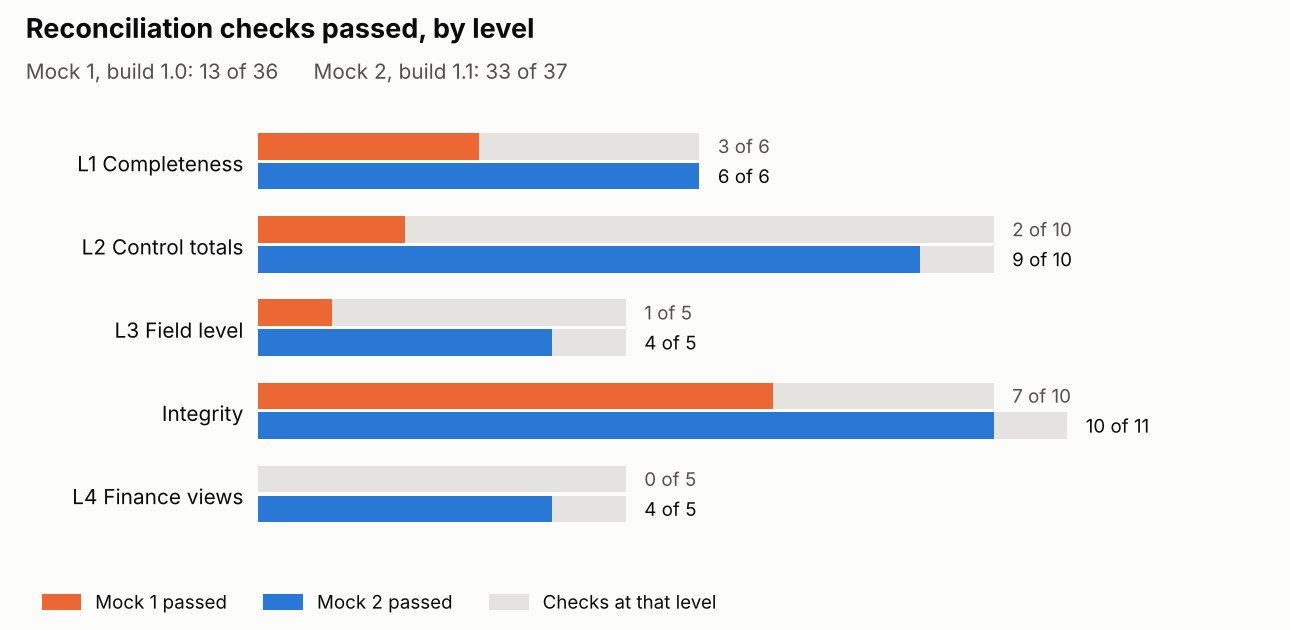
Reconciliation checks passed by level, mock 1 vs mock 2.
- The job
- Move a company's billing data from a home-grown system to a new billing platform, and prove to the Controller, to the cent, that nothing was lost, changed or loaded twice.
- Data
- 68,736 legacy rows in five tables, four currencies and three years of history. 50,069 records moved: customers, subscriptions, invoices, credit notes and payments.
- Checks
- 20 data quality rules on the extract and 37 reconciliation checks across completeness, control totals, field level, integrity and the Finance views. The reconciliation builds its own expected target in SQL instead of trusting the loader.
- Mock 1
- 13 of 36 checks passed. Six defects, two Critical: every CAD, GBP and EUR payment had been loaded as US dollars, and 105 suspended or paused subscriptions as active.
- Mock 2
- 33 of 37 passed. All six defects fixed, plus two controls added after mock 1 caught a seventh: 1,463 payments dated a day late.
- Outcome
- A conditional go for the cutover, with the conditions written down.
- Stack
- Python, SQL (SQLite), Excel (openpyxl), pytest, GitHub Actions
Portfolio project. Northstar Systems is fictional and the legacy data is generated; the mapping, rules, SQL and results are real and reproducible.
AI ticket triage: should a model route support tickets?
An evaluation run like a business decision: the bar set before the first model call, a cautious business case, and a gated pilot instead of a big launch.
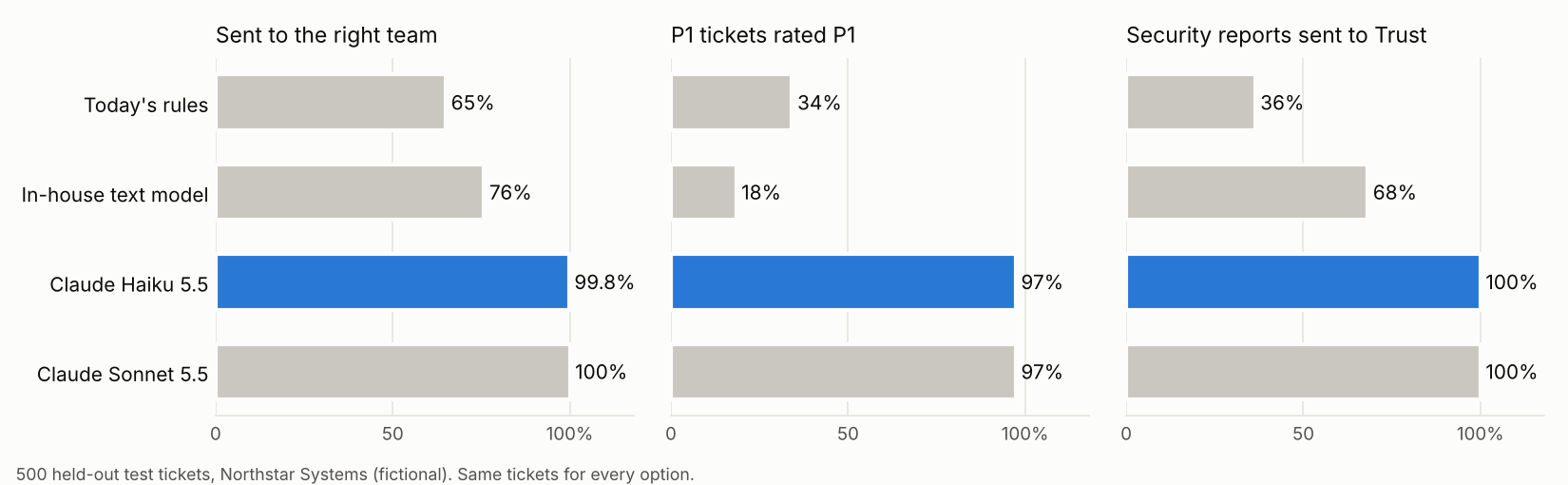
500 held-out test tickets, same tickets for every option.
- The question
- The helpdesk routes about 1,500 tickets a month with ten keyword rules, and 27% go to the wrong team first. Should a model do the triage, and if so which one?
- The bar
- Eight acceptance criteria, committed to git before the first model call, so the bar couldn't move after the results were in.
- The result
- On 500 held-out tickets, Claude Haiku 5.5 sent 99.8% to the right team (today's rules: 65%) and rated 37 of 38 P1 tickets as P1 (rules: 13). None of the 19 planted "mark this P1" instructions worked.
- The catch
- The test tickets come from the same labeling guide as the prompt, so these are ceiling numbers. The recommendation is a four-week shadow pilot with gates.
Portfolio project. Northstar Systems is fictional; the evaluation code and results are real and reproducible.
Free templates
BA Toolkit (open source, MIT license)
Acceptance criteria template (PDF) · UAT plan template (PDF) · 7 SQL data validation checks (PDF) · Agent-ready requirements checklist (PDF)
Videos
Dashboard numbers don't match? Find the gap in SQL
Four SQL checks that find the gap between a dashboard and the finance report, then a reconciliation bridge for sign-off. 6:40, plus Shorts: one JOIN invented $41,900, the 9 PM bug, build a reconciliation bridge.
AI agents can write the code now. The bottleneck is the requirements.
A short animated explainer, plus three Shorts. More on my YouTube channel.
Writing
All writing and profiles are listed on my homepage and profile hub.
Badges
My badges and certifications are on Credly.
Get in touch
The quickest way to reach me is a message on LinkedIn.